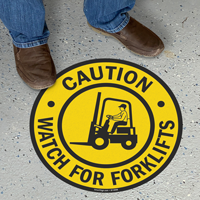
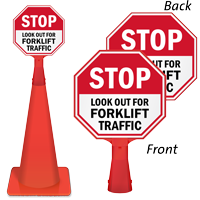
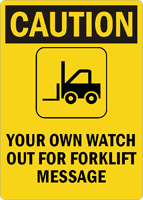
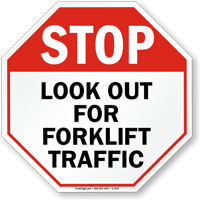
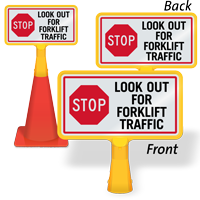
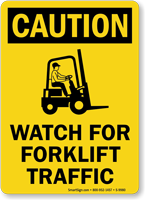
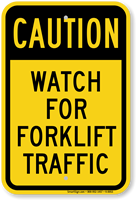
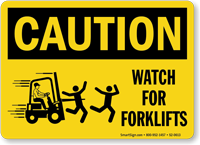
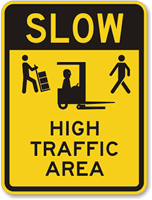
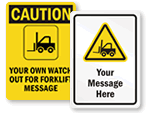
Forklift warning signs must be installed at all high-risk locations where vehicles and pedestrians may interact. According to OSHA's standard 1910.178, this includes pedestrian-vehicle intersections, blind corners, building entrances, and the ends of warehouse aisles. The goal is to alert both drivers and walkers to the potential for a collision before it happens.
Using clear forklift signs is a key part of any warehouse safety plan. For example, a bold "Warning: Forklift Traffic" floor sign can be placed at intersections, while an ANSI danger sign for forklifts should be used at blind corners to command immediate attention.
The primary OSHA requirement, found in 29 CFR 1910.22(b), mandates that "permanent aisles and passageways shall be appropriately marked." This regulation ensures that forklift routes are kept clear and are visibly separate from pedestrian walkways and equipment storage areas.
This marking is typically accomplished using industrial floor marking tape. While OSHA does not specify a color, ANSI standards often recommend yellow. Facilities can use solid floor tape to define the borders of forklift lanes and then use striped hazard tape to mark intersections or areas where extra caution is needed.
Yes, posting forklift speed limits is a vital administrative control for maintaining a safe warehouse. While OSHA 1910.178(n)(8) requires drivers to operate at a speed that is safe for the conditions, it does not set a specific federal limit. The widely accepted industry best practice is to post a 5 mph limit in congested areas, near pedestrian-heavy zones, and at blind corners, with a 10 mph limit for long, open aisles.
These forklift speed limit signs provide a clear, enforceable rule for your operators. A 5 mph traffic sign can be mounted on walls at the end of aisles, while a diamond-shaped floor sign serves as a constant visual reminder within the forklift's path.
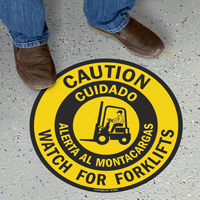
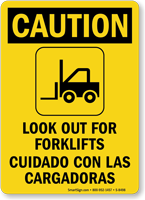
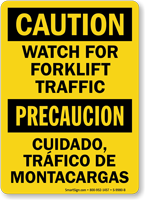
Forklift signs must be understandable by all employees in your facility. According to OSHA's guidelines on multilingual workplaces, safety information must be communicated in languages your workers understand. The best practice is to use ANSI-standard pictograms, which provide a universal, visual warning, paired with text in English and any other language spoken by your staff.
Using bilingual warehouse signs is a key part of an inclusive and effective safety program. This ensures that critical warnings, like a bilingual "Caution Wet Floor" sign or a bilingual PPE required sign, are not missed by any member of your team.
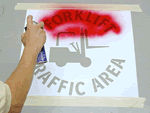
Signs, in combination with floor markings, are the most effective way to separate pedestrian and forklift traffic. As required by OSHA 1910.22, you must mark aisles to create a safe environment. This is done by creating designated routes for people and separate routes for vehicles.
You can use pedestrian floor signs to clearly identify these lanes. Placing a "Pedestrian Walkway" sign within the walking path and a "No Pedestrian Traffic" sign in vehicle-only lanes removes ambiguity and directs traffic safely, especially at intersections and blind corners.
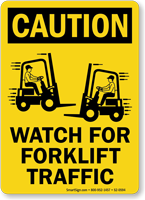
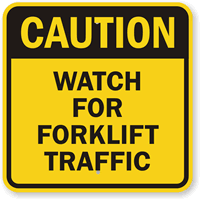
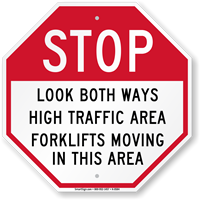
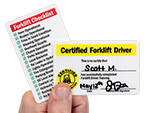
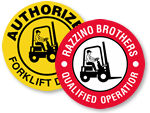
Nothing works better to warn you of potential danger than Watch for Forklift Signs and other Moving Forklift Traffic Signs. Our signs are guaranteed to look great and last for years.
Call our sales team at (800) 952-1457 and get your quote in minutes!
Mon - Fri 8:00am to 7:00pm EST
Best price guarantee. Fast, free shipping.